我的书签
 添加书签
 移除书签
Evaluation
AgentScope provides a built-in evaluation framework for assessing agent performance across different tasks and benchmarks, featuring:
Ray-based parallel and distributed evaluation
Support continuation after interruption
🚧 Visualization of evaluation results
Note
We are keeping integrating new benchmarks into AgentScope:
Overview
The AgentScope evaluation framework consists of several key components:
Benchmark: Collections of tasks for systematic evaluation
Task: Individual evaluation units with inputs, ground truth, and metrics
- Metric: Measurement functions that assess solution quality
Evaluator: Engine that runs evaluation, aggregates results, and analyzes performance
- Evaluator Storage: Persistent storage for recording and retrieving evaluation results
Solution: The user-defined solution

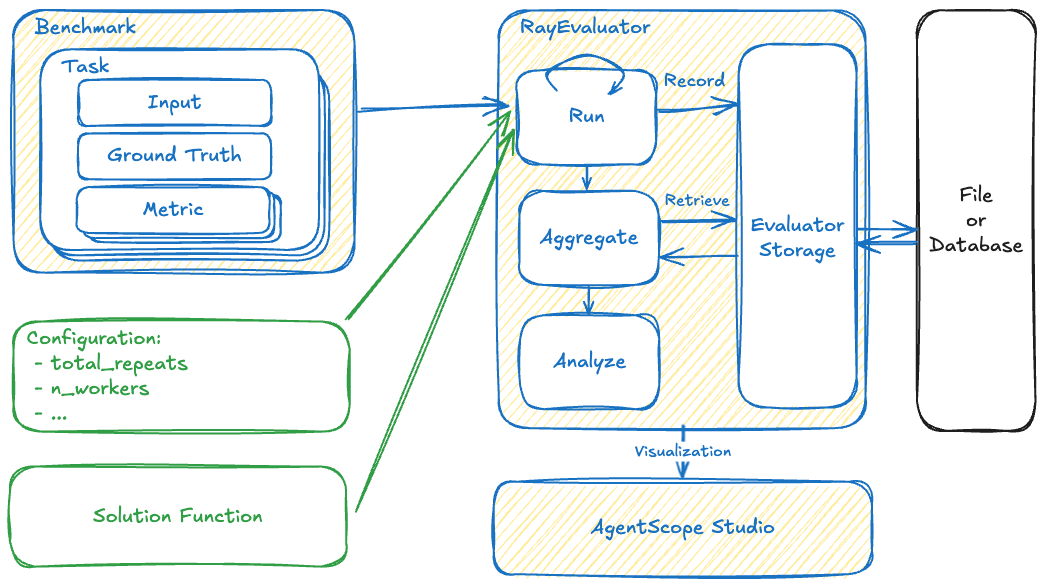
AgentScope Evaluation Framework
The current implementation in AgentScope includes:
Evaluator:
RayEvaluator: A ray-based evaluator that supports parallel and distributed evaluation.GeneralEvaluator: A general evaluator that runs tasks sequentially, friendly for debugging.
Benchmark:
ACEBench: A benchmark for evaluating agent capabilities.
We have provided a toy example in our GitHub repository with RayEvaluator and the agent multistep tasks in ACEBench.
Core Components
We are going to build a simple toy math question benchmark to demonstrate how to use the AgentScope evaluation module.
TOY_BENCHMARK = [{"id": "math_problem_1","question": "What is 2 + 2?","ground_truth": 4.0,"tags": {"difficulty": "easy","category": "math",},},{"id": "math_problem_2","question": "What is 12345 + 54321 + 6789 + 9876?","ground_truth": 83331,"tags": {"difficulty": "medium","category": "math",},},]
From Tasks, Solutions and Metrics to Benchmark
A
SolutionOutputcontains all information generated by the agent, including the trajectory and final output.A
Metricrepresents a single evaluation callable instance that compares the generated solution (e.g., trajectory or final output) to the ground truth.
In the toy example, we define a metric that simply checks whether the output field in the solution matches the ground truth.
from agentscope.evaluate import (SolutionOutput,MetricBase,MetricResult,MetricType,)class CheckEqual(MetricBase):def __init__(self,ground_truth: float,):super().__init__(name="math check number equal",metric_type=MetricType.NUMERICAL,description="Toy metric checking if two numbers are equal",categories=[],)self.ground_truth = ground_truthdef __call__(self,solution: SolutionOutput,) -> MetricResult:if solution.output == self.ground_truth:return MetricResult(name=self.name,result=1.0,message="Correct",)else:return MetricResult(name=self.name,result=0.0,message="Incorrect",)
A
Taskis a unit in the benchmark that includes all information for the agent to execute and evaluate (e.g., input/query and its ground truth).A
Benchmarkorganizes multiple tasks for systematic evaluation.
from typing import Generatorfrom agentscope.evaluate import (Task,BenchmarkBase,)class ToyBenchmark(BenchmarkBase):def __init__(self):super().__init__(name="Toy bench",description="A toy benchmark for demonstrating the evaluation module.",)self.dataset = self._load_data()@staticmethoddef _load_data() -> list[Task]:dataset = []for item in TOY_BENCHMARK:dataset.append(Task(id=item["id"],input=item["question"],ground_truth=item["ground_truth"],tags=item.get("tags", {}),metrics=[CheckEqual(item["ground_truth"]),],metadata={},),)return datasetdef __iter__(self) -> Generator[Task, None, None]:"""Iterate over the benchmark."""for task in self.dataset:yield taskdef __getitem__(self, index: int) -> Task:"""Get a task by index."""return self.dataset[index]def __len__(self) -> int:"""Get the length of the benchmark."""return len(self.dataset)
Evaluators
Evaluators manage the evaluation process. They can automatically iterate through the tasks in the benchmark and feed each task into a solution-generation function, where developers need to define the logic for running agents and retrieving the execution result and trajectory. Below is an example of running GeneralEvaluator with our toy benchmark. If there is a large benchmark and the developer wants to get the evaluation more efficiently through parallelization, RayEvaluator is available as a built-in solution as well.
import osimport asynciofrom typing import Callablefrom pydantic import BaseModelfrom agentscope.message import Msgfrom agentscope.model import DashScopeChatModelfrom agentscope.formatter import DashScopeChatFormatterfrom agentscope.agent import ReActAgentfrom agentscope.evaluate import (GeneralEvaluator,FileEvaluatorStorage,)class ToyBenchAnswerFormat(BaseModel):answer_as_number: floatasync def toy_solution_generation(task: Task,pre_hook: Callable,) -> SolutionOutput:agent = ReActAgent(name="Friday",sys_prompt="You are a helpful assistant named Friday. ""Your target is to solve the given task with your tools. ""Try to solve the task as best as you can.",model=DashScopeChatModel(api_key=os.environ.get("DASHSCOPE_API_KEY"),model_name="qwen-max",stream=False,),formatter=DashScopeChatFormatter(),)agent.register_instance_hook("pre_print","save_logging",pre_hook,)msg_input = Msg("user", task.input, role="user")res = await agent(msg_input,structured_model=ToyBenchAnswerFormat,)return SolutionOutput(success=True,output=res.metadata.get("answer_as_number", None),trajectory=[],)async def main() -> None:evaluator = GeneralEvaluator(name="ACEbench evaluation",benchmark=ToyBenchmark(),# Repeat how many timesn_repeat=1,storage=FileEvaluatorStorage(save_dir="./results",),# How many workers to usen_workers=1,)# Run the evaluationawait evaluator.run(toy_solution_generation)asyncio.run(main())
Friday: The sum of 2 + 2 is 4.Friday: The sum of 12345, 54321, 6789, and 9876 is 83331.Repeat ID: 0Metric: math check number equalType: MetricType.NUMERICALInvolved tasks: 2Completed tasks: 2Incomplete tasks: 0Aggregation: {"mean": 1.0,"max": 1.0,"min": 1.0}
Total running time of the script: (0 minutes 9.368 seconds)
Download Jupyter notebook: task_eval.ipynb
Download Python source code: task_eval.py